
Explore the Interpersonal and Applied Communication degree program
Strong relationships are built on effective communication — in families, communities, and organizations. The Interpersonal and Applied Communication degree program at Wayne State College builds your skills in understanding people, resolving conflicts, and fostering dialogue across cultures and contexts. Courses cover small-group and family communication, health, environmental, and intercultural communication, plus the ethics of persuasion and media. You’ll graduate ready to make a difference in everyday interactions and applied settings, with career paths in human resources, health care, nonprofit leadership, counseling, and community engagement.
Fast facts
Degree options: B.A. or B.S. in Communication Studies/Interpersonal and Applied Communication
Delivery format: On campus (Wayne)
Program credit hours: 36 or 48
- Communication studies core (18 credit hours)
- Interpersonal and applied communication concentration (18 or 30 credit hours)
Note: Students must also take 30 credit hours of General Studies courses. A total of 120 credit hours are needed to graduate from WSC. Additional majors or minors can be added to help meet graduation requirements.
School: Arts and Humanities
Department: Communication Arts
Opportunities and outcomes
Interpersonal and applied communication topics covered
- Interpersonal and group communication
- Management of communication within an organization
- Communicating about specific topics including health, illness, and the environment
- Cultural and contextual communication
- Family systems and communication
- Media and its effects on society
Student learning outcomes
- Demonstrate knowledge of the basic concepts of interpersonal communication, public address, communication theory, organizational communication, and argumentation. Students demonstrate knowledge through exams, written materials, theatre performances, and classroom projects.
- Demonstrate communication skill through student presentations in theatre productions, acting, workshops, forensics, interpersonal, small group, argumentation, public speaking, public relations, leadership, and organizational communication classes.
- Demonstrate application of communication studies and theatre arts through participation in workshops, forensics, internships, service-learning projects, communication conference participation, and senior portfolio development.
Career Scholars Program
Students studying Interpersonal and Applied Communication are eligible to take part in the Career Scholars Program. The Career Scholars Program offers a generous scholarship package while you embark on a unique cooperative education journey starting your freshman year at Wayne State. During your time here, you’ll participate in career readiness activities, business site visits, job shadowing, and more - all while learning the fundamentals of professional practice. After three years on campus, you’ll complete your senior year by working at a paid job in your chosen field. Job locations include Norfolk or Grand Island, Neb., where you'll live in community housing with fellow Career Scholars students.
Intercollegiate forensics
The Wayne State Forensics Team is a competitive speech team that provides students the opportunity to grow their skills in oral and written communication, critical thinking, research development, creativity, leadership, and confidence. The team competes regionally and nationally in a variety of public address and interpretation event categories, including communication analysis/rhetorical criticism; persuasive, informative, extemporaneous, impromptu, and after dinner speaking; and dramatic and prose interpretation.
Communication internships
Our outstanding Career Services Office is available to help you find interpersonal and applied communication internships and career opportunities. Students recently completed communication internships at the following locations:
- Children’s Hospital
- Logan Valley Contracting
- Rural Futures Institute
- St. Mary’s Catholic Church
- UNMC Behavioral Health Education Center of Nebraska
- Wayne Baseball Association
- Wayne State College
- WJAG Radio
Graduates work in their chosen field using the skills they learned while at Wayne State College. Each year, eager employers welcome WSC graduates into their organizations.
Note: Due to the recent addition of the Interpersonal and Applied Communication program, career outcomes will be available for reporting beginning in Summer 2030 with the 2028-29 Graduate Outcomes Survey.
Possible careers:
- Professional speaker /presenter
- Public relations specialist
- Communications specialist
- Marketing director
- Human resource specialist
- Speech pathologist
- Writer or journalist
- Ministry
- Teaching/coaching
- Event planner

job or grad school placement rate
within six months of graduation
Data based on most recent
employment outcomes survey

2025-26 Estimated Annual Cost of Attendance
cost per credit hour
Tuition: $6,057
Fees: $2,351
Food plan: $4,830
Housing: $4,870
Least Expensive College in Nebraska
- CollegeTuitionCompare, 2025
Wayne State College is ranked the No. 1 least expensive four-year college in Nebraska and is recognized among the Top 10 most affordable colleges in the nation for out-of-state students. With the same tuition rates for in- and out-of-state students, a tuition guarantee, and generous scholarship opportunities, WSC makes earning a degree both accessible and affordable. In fact, the average remaining annual cost of attendance for 2024–25 is just $2,268 for undergraduate students after financial aid and scholarships.
Interpersonal and Applied Communication degree program courses
Students must complete the communication studies core courses and interpersonal and applied communication concentration courses. Students have the option of a 36-hour or 48-hour program. A total of 120 credit hours are needed to graduate from WSC. Additional majors or minors can be added to help meet graduation requirements.
Communication studies core courses (18 credits)
Choose one of the following courses:
- CNA 201 Small Group Communication (3 credits) - Explores the functions of discussion in our society, problem-solving, group dynamics, and analysis of the operative forces within the group. Emphasis on skills of group discussion, participation in decision-making groups, leadership, organization, and evaluation.
- CNA 210 Interpersonal Communication (3 credits) - The study of theories and models of interpersonal communication that enhance understanding and development of interpersonal relationships. Skills are developed in listening behavior, dyadic interaction, relationship and conflict management, verbal and nonverbal communication, and intrapersonal processing.
Note: For students in the Organizational Leadership and Public Relations program, BUS 350 Managing Behavior in Organizations may be substituted for this course.
Credits: 3
Description: Explores the nature and function of communication in organizations. Emphasis on concepts, skills for effective management of communication, analysis, and evaluation of formal and informal patterns of communication in organizations.
Credits: 3
Description: The study of various theories and models typically employed in communication studies today. Students explore the central assumptions, questions, and approaches in the study of human communication.
Credits: 3
Description: Capstone course that involves the investigation of recent and ongoing research and theory in major field and their implications for continued research and field applications. Extensive training in listening, interviewing, and research skills. Completion of program portfolio required. Topics will vary from offering to offering. Cannot be repeated.
Interpersonal and applied communication concentration (18 or 30 credit hours)
Students pursuing the 36-credit-hour program will take the following courses for 18 credit hours in addition to the communication studies core:
Credits: 3
Description: A description has not been provided in the catalog.
Credits: 3
Description: Explores theories, research, and applications of the symbolic processes by which people, both individually and collectively, understand and share ideas about health and illness. The course focuses on the communicative implications of health beliefs, practices, and policies with special emphasis on the core communication competencies of a health citizen, as well as the communication challenges for the health care practitioner.
Prerequisite: CNA 100 Principles of Human Communication
Credits: 3
Description: A course aimed at developing a thorough understanding of communication and culture, in both global and community settings, and the way members of diverse cultures and subcultures utilize unique systems, symbols and media representation to communicate among themselves and other groups. Emphasis on media representation of minority groups and U.S. sponsored health/public welfare campaigns in developing nations will enable students to critically assess the communication process in a cultural context.
Credits: 3
Description: An in-depth study of family communication concepts including family systems, roles, networks, power, intimacy, and decision-making. Special attention will be given to research affecting family communication in such areas as gender, culture, race, and age.
Prerequisite: CNA 100 Principles of Human Communication
Choose one of the following (not taken in the core):
- CNA 201 Small Group Communication (3 credits) - Explores the functions of discussion in our society, problem-solving, group dynamics, and analysis of the operative forces within the group. Emphasis on skills of group discussion, participation in decision-making groups, leadership, organization, and evaluation.
- CNA 210 Interpersonal Communication (3 credits) - The study of theories and models of interpersonal communication that enhance understanding and development of interpersonal relationships. Skills are developed in listening behavior, dyadic interaction, relationship and conflict management, verbal and nonverbal communication, and intrapersonal processing.
Choose three of the following courses:
- CNA 252 Public Address (3 credits) - This course sets the foundation of communication theory by setting the stage of the first roots of the western heritage in rhetoric. Students will learn how the art and skills of rhetoric evolved beginning with the Greeks of Plato and Aristotle, through the Romans of Cicero and Quintilian, through the Christianization of rhetoric in St. Augustine, and ending with the Ramian and Cartesian turns leading into modern thought and practice of communication theory. Prerequisite: CNA 100 Principles of Human Communication.
- CNA 302 Language and Human Behavior (3 credits) - Examines in depth the relationship among language, thought, and behavior, emphasizing the role linguistic communication plays in culture and society. Prerequisite: CNA 100 Principles of Human Communication.
- CNA 342 Persuasion (3 credits) - The study of contemporary theories of persuasion and their applications. Persuasive appeals in political campaigns, social movements, and advertising are examined. Prerequisites: CNA 100 Principles of Human Communication and sophomore standing.
- CNA 372 Media Ethics (3 credits) - An in-depth investigation of the ethical foundations underlying conduct of media professionals.
- CNA 426 Public Relations through Social Media (3 credits) - An introduction to current systems and practices used in Public Relations to create and maintain Internet-based interactive communications with customers and constituents. Students will create content hands-on and will be able to apply a conceptual framework including branding programs, Integrated Marketing Communications, and other professional, legal, and ethical standards and practices. This course draws from the fields of public relations writing, photography, video production, and/or other types of multimedia content creation.
- CNA 451 Speech Pathology (3 credits) - Characteristics, causes, and treatment of speech and hearing disorders. Designed for teachers to aid in recognizing speech and language disorders in the classroom. Prerequisite: CNA 100 Principles of Human Communication.
- CNA 453 Integrated Brand Promotion (3 credits) - An exploration of strategic communication combining advertising, public relations, sales promotions, direct marketing, and other marketing communication functions to build relationships with constituents for business, organizations, and other groups. Includes case studies and hands-on projects. Prerequisite: Junior standing or instructor approval.
- CNA 457 Special Topics in Communication (3 credits) - A detailed study of a particular aspect of communication, such as but not limited to political communication, gender and communication, communication and aging. Notes: Topic varies, and the course can be repeated up to three times for credit covering a different topic.
- CNA 465 Qualitative Research Design (3 credits) - This course is an introduction to the methodology and practice of qualitative research. The focus of this course is on five different approaches to qualitative research: Narrative Inquiry, Phenomenology, Case Study, Ethnography, and Grounded Theory. Students will collect and analyze qualitative data and develop a mini-qualitative research project. Prerequisite: Junior standing.
- CNA 471 Mass Media and Society (3 credits) - In-depth critical perspective of mass communication theoretical development and audience effects, including short and long term media socialization, political propaganda, advertising, social control, and characteristics shared by all media. Prerequisite: CNA 263 Introduction to Mass Communication.
- CNA 478 Communication Ethics (3 credits) - Explores communication and ethics in various areas of communication studies (i.e., interpersonal, small group, organizational, political, family, health, and media communication). The course will examine ethical dimensions of communication such as truthfulness, openness, politeness, sensitivity to others, listening, respect, and storytelling through the domain of popular discourse of film and television. Students will learn how to conduct a discourse analysis in their areas of interest through the examination of ethical messages in a variety of communication situations portrayed in film, television, or texts. Prerequisite: CNA 100 Principles of Human Communication.
Students pursuing the 48-hour program will take the above courses from the 36-hour option plus an additional 12 credit hours from the following:
- BUS 208 Business Communications
- BUS 260 Management Theory and Practice (3)
- BUS 270 Principles of Marketing (3)
- BUS 367 Foundations of Human Resource Management (3)
- BUS 374 Advertising and Integrated Marketing (3)
- CNA 140/240/440 Intercollegiate Forensics (0-3)
- CNA 263 Introduction to Mass Communication (3)
- CNA 280 News Writing (3)
- CNA 302 Language and Human Behavior (3)
- CNA 318 Directing
- CNA 322 Children’s Theatre (3) or 339/439 Musical Theatre (3)
- CNA 333 American Theatre (3) or 386 Modern World Drama (3)
- CNA 337 Costumes and Make Up for the Stage and Screen (3)
- CNA 342 Persuasion (3)
- CNA 352 Organizational Presentations (3)
- CNA 374 Public Relations (3)
- CNA 382 Movement Specialties: Combat for the State and Screen
- CNA 419 Advanced Directing (3)
- CNA 426 Public Relations Through Social Media (3)
- CNA 431 Advanced Design (3)
- CNA 443 Theatre Management (3)
- CNA 450 Media Design Applications (3)
- CNA 452 Public Relations Case Studies (3)
- CNA 453 Integrated Brand Promotion (3)
- CNA 457 Special Topics in Communication (3)
- CNA 459 Organizational Leadership (3)
- CNA 462 Communication Research Methods (3)
- CNA 465 Qualitative Research Design (3)
- CNA 470 Family Communication (3)
- CNA 471 Mass Media and Society (3)
- CNA 475 Communication Law (3)
- PSY 435 Industrial/Organizational Psychology (3)
- SSC 300 Social Sciences Research Methods (3)
- SSC 319 Statistics for the Social Sciences (3)
Popular pairings
Many students at Wayne State will add a second major or a minor to complement their program of study, or to focus their studies on a specific topic. Suggested pairings include:
- Business Administration
- English Writing and Literature
- Human Resource Management
- Political Science
- Psychology
- Theatre Arts
Related programs
Students interested in the Interpersonal and Applied Communication degree program may also be interested in:
Agricultural Communication and Leadership (B.A. or B.S.)
Journalism (B.A. or B.S.)
Rhetoric, Influence, and Civic Engagement (B.A. or B.S.)
Theatre Arts (B.A. or B.S.)

Transfer to Wayne State
Our generous transfer credit policy will allow you to get credit for what you've already earned.
- If you've taken courses at other institutions, you can transfer those credits to Wayne State.
- Already have an associate degree? Seamlessly transfer your full degree through one of our transfer pathways.
- Military or veteran student? You may be able to get credit for your military experience and training.
Communication Arts Department faculty

Sean Ahern, Ph.D.
Associate Professor
Dr. Sean Ahern is a communication arts professor at Wayne State College and is the advisor for the on-campus radio station KWSC-FM 91.9 The Cat.

Brian Begley, MFA
Associate Professor
Brian Begley is a communication arts professor at Wayne State College and technical director and designer for the theatre program. He teaches lighting and set design, technical theatre, play writing, and acting specialties, including performance for the camera and stage combat.

Robbie Hall, Ph.D.
Assistant Professor
Dr. Robbie Hall is an assistant professor of communication arts at Wayne State College. He teaches courses in interpersonal communication, health communication, organizational communication, and qualitative research methods.

Pat Janssen, MFA
Assistant Professor
Pat Janssen teaches in the Communication Arts Department at Wayne State College. His academic interests include journalism ethics, sports and popular culture, social commentary in comedy, ethical film production, Midwestern narratives, and the relationship between politics and mass media.

Allyn Lueders, Ph.D.
Professor
Dr. Allyn Lueders is a communication studies professor at WSC. She teaches undergraduate courses in public relations and interpersonal communication and graduate courses in public relations leadership. She is the chair of the Communication Arts Department.

Teresa Morales, Ph.D.
Professor
Dr. Teresa Morales is a communication arts professor at Wayne State College. In addition to teaching CNA 100 Principles of Human Communication, she also teaches Public Address, Argumentation, Persuasion, the Rhetoric of Civic Life, Professional Presentations, Language and Human Behavior, Organizational Leadership, Leadership Theory, and Case Studies in Organizational Leadership.

Rusty Ruth, MFA
Associate Professor
Rusty Ruth is a communication arts professor at Wayne State College. He teaches acting, directing, dramatic literature, and stage dialect courses.
Mike White, Ed.D.
Associate Professor
Dr. Mike White is a communication arts professor and teaches television and video production, electronic media, and other mass communication courses at Wayne State College. He advises KWSC-TV, the college’s cable television station, serving Wayne and streamed online. White also oversees the KWSC Productions (The Hot Attic), the student video and the short film production studio.

Joe Whitt, Ph.D.
Assistant Professor
Dr. Joe Whitt is a communication arts professor at Wayne State College. He specializes in human communication, particularly in interpersonal, intercultural, family, small group, environmental, and organizational contexts.
Get in touch
Department of Communication Arts
Humanities Building, Room 213
Phone: 402-375-7395
Clubs for students studying interpersonal and applied communication
Civic Leadership at Wayne State (CLAWS) - An organization focused on building a bridge between the community of Wayne and Wayne State College
Lambda Pi Eta - National honor society for communication majors
Pi Kappa Delta - Communication honorary
Wildcat PR in ACTion - Focuses on improving the practice of public relations

Rankings and accolades
Recognized for excellence
Best Colleges in Nebraska for Communication and Rhetoric
Ranked among Nebraska’s top programs for speech communication and rhetoric in CollegeRaptor’s 2026 Best Colleges rankings.
A Best College of Distinction
Wayne State was recognized as a College of Distinction for our commitment to affordability, accessibility, and strong student outcomes that deliver a proven return on investment.

A Top Public College in the Midwest
Wayne State College is ranked among the top public colleges in the Midwest for 2026 by U.S. News & World Report, reflecting strong academics and student outcomes.
Where you'll learnDepartment facilities

Humanities Building
The Humanities Building is home to students in media, communication, language, and literature programs at Wayne State.

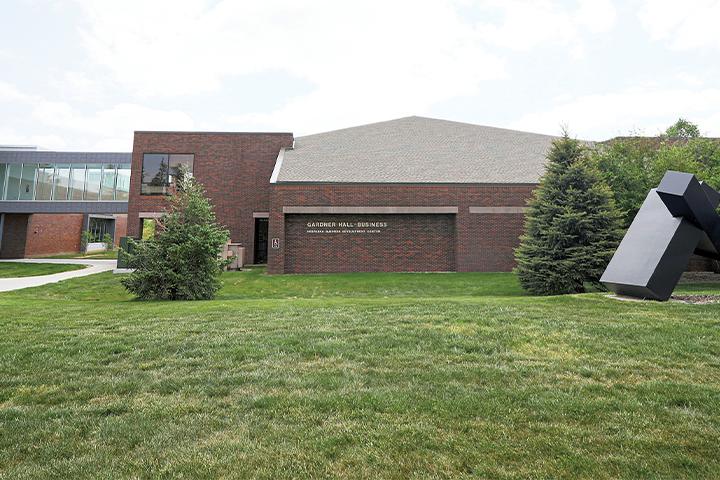
Gardner Hall
Gardner Hall is home to the Department of Business and Economics at WSC and connects to advanced computer labs in the Center for Applied Technology by skywalk.
Your next steps