
Your path to osteopathic medical school
Honors Program
Honors students complete an independent research project usually spanning their junior and senior years. Your research can take you just about anywhere - in the lab or library, in the community, or in the U.S. or abroad! Honors work can also be very practical. Prospective employers and graduate admissions committees often look carefully at an undergraduate record for evidence of extra initiative and genuine intellectual strength.
Learn more about the Honors Program
Pre-Osteopathic Medicine internships and job shadowing
The Academic and Career Success Center is available to help you find internships and career opportunities. Students recently completed internships at the following locations:
- Faith Regional Health Services (Norfolk, Neb.)
- Franciscan Healthcare (West Point, Neb.)
- MercyOne Siouxland Medical Center (Sioux City, Iowa)
- Providence Medical Center (Wayne, Neb.)
- Sidney Regional Medical Center (Sidney, Neb.)
Topics covered in the Pre-Osteopathic Medicine pathway
Depending on your chosen major and medical school prerequisites, your studies may include:
- Biological sciences
- Human anatomy and physiology
- Molecular biology and genetics
- Microbiology and immunology
- General and organic chemistry
- Biochemistry
- Physics
- Scientific research and data analysis
- Laborator techniques and research methods
This timeline is a general guide for students following a traditional four-year undergraduate path to osteopathic medical school. Admission requirements and application timelines vary by school, so work closely with your advisor and review requirements for each medical school you are considering.
Freshman year
- Meet with your Pre-Osteopathic Medicine program advisor to choose a major, plan prerequisite courswork, and discussion opportunities for job shadowing, clinical experience, service, internships, and research.
- Build a strong foundation, particularly in your science courses.
- Join the Health Science Club or other campus organizations to engage in health-related activities and participate in networking events.
- Begin learning about osteopathic medicine and researching D.O. schools and their admission requirements. Be mindful of prerequisite course and GPA requirements, location, costs, program reputation, and entrance exams score requirements. Inquire with the professional school for any specific questions or guidance.
Sophomore year
- Continue completing prerequisit coursework and maintaining a strong academic record.
- Gain health care experience through job shadowing, volunteering, employment, internships, or other opportunities.
- Continue researching osteopathic medical schools, including prerequisite courses, GPA expectations, costs, locations, and admission requirements.
- Study and practice for the Medical College Admissions Test (MCAT).
- Take the free practice MCAT exam available at WSC each semester.
Interested in the KCU accelerated pathway?
Meet with your pre-health advisor early in your sophomore year. Students who meet Kansas City University’s eligibility guidelines may receive an application link in December and may be invited to interview with KCU during the spring semester.
Junior year
- Continue prerequisite and upper-level science coursework and take the MCAT according to your application plan.
- Identify individuals who can provide strong letters of recommendation and review the requirements of the medical schools you plan to apply to.
- Continue clinical experience, community service, job shadowing, research, and other activities that demonstrate your preparation for medicine.
- Develop your personal statement and prepare other application materials.
Begin the AACOMAS application process when it opens and submit a complete application as early as practical. - Complete secondary applications and prepare for medical school interviews.
KCU accelerated pathway: Students accepted through KCU’s partner program return to Wayne State for their junior year to complete required coursework. After completing at least 90 undergraduate credit hours and satisfying KCU requirements, they may matriculate at KCU and forego the traditional senior year.
Senior year
- Complete your major, remaining prerequisite coursework, and bachelor’s degree requirements.
- Complete secondary applications and participate in interviews as requested by medical schools.
- Continue gaining meaningful clinical, service, leadership, and academic experiences.
- Review admissions offers, financial aid, and other factors as you choose the medical school that is right for you.
- Complete any final requirements for matriculation and prepare to begin medical school after graduation.
Graduates of the Pre-Osteopathic Medicine program work in their field or continue their studies using the skills they learned while at Wayne State College. Each year, medical schools and employers welcome WSC graduates into their organizations.
Recent grads are pursuing their medical degrees at the following schools:
- A.T. Still University – Kirksville College of Osteopathic Medicine (Kirksville, Mo.)
Career possibilities:
- Osteopathic physician
- Family physician
- Primary care physician
- General surgeon
- Rehabilitation physician
- Internal medicine specialist
- Diagnostic medical specialist
- Clinical professor

job or grad school placement rate
within six months of graduation
Data based on most recent
employment outcomes survey

Transfer to Wayne State
Our generous transfer credit policy will allow you to get credit for what you've already earned.
- If you've taken courses at other institutions, you can transfer those credits to Wayne State.
- Already have an associate degree? Seamlessly transfer your full degree through one of our transfer pathways.
- Military or veteran student? You may be able to get credit for your military experience and training.
Life Sciences Department faculty

Douglas Christensen, Ph.D.
Professor
Dr. Doug Christensen is a biology professor at Wayne State College. His teaching interests include utilization of molecular biology in a broad range of sciences (including medical, environmental, and industrial fields); teaching about battles between the immune system and the evolving world of bacteria and viruses; microbiology; molecular genetics; and immunology.

Buffany DeBoer is a biology instructor at Wayne State College. Her teaching interests are general education biology and environmental science.

Dr. Mark Hammer is a biology professor at Wayne State College. He advises students who are interested in a career as a conservation biologist, physician assistant (including RHOP pre-PA), or occupational therapist. He is also the director of the A. Jewell Schock Natural History Museum.

Michael Mutehart, Ph.D.
Associate Professor
Dr. Michael Mutehart is a life sciences professor at Wayne State College. Mutehart has a strong background in clinical anatomy education. His teaching responsibilities are mainly in the field of human gross anatomy and its related counterparts (histology, comparative anatomy, etc.).

Dr. Shawn Pearcy is a biology professor at Wayne State College. His teaching interests are biology, human physiology, vertebrate embryology, and physiological ecology.

Danielle Peekenschneider, Ph.D.
Professor
Dr. Danielle Peekenschneider is a biology professor at Wayne State College. Her teaching interests include general education biology, oncology, and immunology.

Jillian Wormington, Ph.D.
Associate Professor
Dr. Jillian Wormington is a biology professor at Wayne State College and the zoological curator of the A. Jewell Schock Natural History Museum.
Student clubs for pre-professional health majors
Exercise is Medicine - Works toward improving the health and well-being of the campus community
Health Science Club - For students pursuing careers in health-related fields
Physician Assistant Club - For students in the PA program or interested in healthcare

Nebraska’s Most Affordable Health Care Degree Programs
Wayne State College ranks No. 1 in Nebraska for affordable health care degree programs, highlighting strong preparation for careers in medicine and allied health.
A Best College of Distinction
Wayne State College is one of only two public colleges in Nebraska recognized as a Best College of Distinction for excellence in teaching, student engagement, campus community, and student success.

Best College for Health Sciences in Nebraska
CampusReel ranked Wayne State College among the best colleges in Nebraska for Health Science in its 2026 rankings, based on alumni salaries, student debt, and long-term value.
A Top Public College in the Midwest
Wayne State College is ranked among the top public colleges in the Midwest for 2026 by U.S. News & World Report, reflecting strong academics and student outcomes.
Where you'll learn
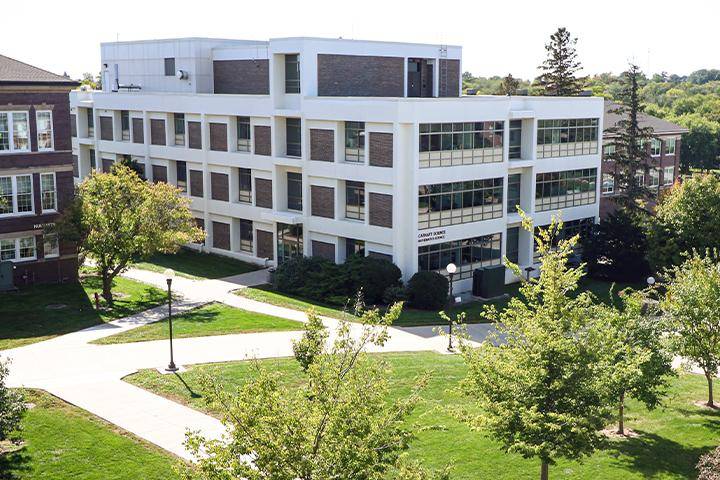
Students in this program will take courses in Carhart Science, home to WSC's math and science programs. Carhart Science features several labs for chemistry, biochemistry, anatomy, physiology, plant science, zoology, genetics, microbiology, physics, Earth science, fermentation, and science education. Additionally, there is a molecular-based student research lab, microscopy suite, a cadaver lab, and a cell culture facility.