
Your path to becoming a sonographer
Rural Health Opportunities Program (RHOP)
The Pre-DMS pathway is eligible for RHOP, a program designed for rural Nebraska students interested in returning to rural areas to practice sonography. In this program, you’ll complete three years at Wayne State before entering a DMS program at the University of Nebraska Medical Center (UNMC). Participants in RHOP receive a full-tuition scholarship at WSC, guaranteed admission to UNMC, job shadowing and internship experiences, one-on-one advising, and early registration privileges.
Rural Health Opportunities Program
Pre-DMS internships and job shadowing
Our outstanding Academic and Career Success Center is available to help you find internships and career opportunities. Students have previously completed internships at the following locations:
- Faith Regional Health Services (Norfolk, Neb.)
- Franciscan Healthcare (West Point, Neb.)
- MercyOne Siouxland Medical Center (Sioux City, Iowa)
- Providence Medical Center (Wayne, Neb.)
- Sidney Regional Medical Center (Sidney, Neb.)
Topics covered in the Pre-DMS program
- Human anatomy and physiology
- Biological systems and structures
- General chemistry and physics
- Research, data collection, and analysis
- Modern lab techniques
The DMS pathway prepares students to become a sonographer.
To become a sonographer, students must complete a three-step process:
- Complete a preparatory undergraduate course of study.
- Earn a bachelor's degree in a sonography from an approved graduate program.
- Pass the national certification exam.
In this pathway, you will attend Wayne State and then enter UNMC’s (or another school's) sonography program. Be sure to consult with your advisor to learn about the options available for you.
Graduates of the Pre-DMS program work in their field or continue their studies using the skills they learned while at Wayne State College.
Career possibilities:
- Diagnostic medical sonographer
- Sonographer / ultrasound technician
- Radiology technologist
- Computed tomography technologist
- Radiation therapist
- MRI technologist
- Nuclear medicine technologist

job or grad school placement rate
within six months of graduation
Data based on most recent
employment outcomes survey

Transfer to Wayne State
Our generous transfer credit policy will allow you to get credit for what you've already earned.
- If you've taken courses at other institutions, you can transfer those credits to Wayne State.
- Already have an associate degree? Seamlessly transfer your full degree through one of our transfer pathways.
- Military or veteran student? You may be able to get credit for your military experience and training.
Department faculty

Dr. Darius Agoumba is a chemistry professor at Wayne State College. His teaching interests are general chemistry, analytical chemistry, and instrumental analysis.

DJ Black JR, Ph.D.
Associate Professor
Dr. DJ Black is a professor in the Physical Sciences and Mathematics Department at Wayne State College. He teaches biochemistry, organic chemistry, and other subdisciplines in chemistry directly relevant to the health sciences.

Brett Cagg, Ph.D.
Associate Professor
Dr. Brett Cagg is a chemistry professor at Wayne State College. His teaching responsibilities are general chemistry, thermodynamics, quantum mechanics, and applications of quantum mechanics.

Dr. Adam Davis is a physics professor at Wayne State College. He is also the pre-engineering advisor and physics lab director.

Rob Engel teaches in the Department of Physical Science and Mathematics. He teaches courses related to science teacher education and general science.

Dr. Mary Ettel is a chemistry professor at Wayne State College. She is the contact for the RHOP pre-radiography program.

Dr. Mary Kuchta is a mathematics professor at Wayne State College. Kuchta's teaching interests include the teaching of mathematics and working with mathematics teacher education students.

Jennifer Langdon, Ph.D.
Professor
Dr. Jennifer Langdon is a mathematics professor at Wayne State College. Her academic interests include collegiate math and statistics education, and dynamic equations on time scales.

Michael Marmorstein, Ph.D.
Assistant Professor
Dr. Michael Marmorstein is a mathematics professor at Wayne State College. His primary mathematical interest is abstract algebra; his technical focus is on abstract objects like rings, ideals, and modules, but he also enjoys applications of the subject to geometry, cryptography, physics, and other areas of math and science.

Dr. Al Mitchell is a mathematics professor at Wayne State College. Mitchell's academic interests include complex dynamical systems, in which many beautiful fractal pictures can be made observing families of functions in this topic, as well as any other math topics. He welcomes any mathematical conversation.

Dr. David Peitz is a chemistry professor at Wayne State College. He teaches organic chemistry and general physical science classes.

Jason Price, Ph.D.
Associate Professor
Dr. Jason Price is an Earth science professor at Wayne State College. He teaches courses in all of the Earth sciences, including geology, meteorology, climate change, and hydrology, as well as physics labs. He serves as the geological curator of the A. Jewell Schock Natural History Museum.

Dr. Todd Young is a physics and astronomy professor at Wayne State College. He is the director of the Fred G. Dale Planetarium on WSC's campus and serves as the coordinator of the Rural Health Opportunities Program (RHOP).
Student clubs for pre-professional health majors
Exercise is Medicine - Works toward improving the health and well-being of the campus community
Health Occupation Students of America (HOSA) - For students preparing to become health care professionals
Health Science Club - For students pursuing careers in health-related fields
Physician Assistant Club - For students in the PA program or interested in healthcare

Nebraska’s Most Affordable Health Care Degree Programs
Wayne State College ranks No. 1 in Nebraska for affordable health care degree programs, highlighting strong preparation for careers in medicine and allied health.
A Best College of Distinction
Wayne State College is one of only two public colleges in Nebraska recognized as a Best College of Distinction for excellence in teaching, student engagement, campus community, and student success.
Best College for Health Sciences in Nebraska
CampusReel ranked Wayne State College among the best colleges in Nebraska for Health Science in its 2026 rankings, based on alumni salaries, student debt, and long-term value.
A Top Public College in the Midwest
Wayne State College is ranked among the top public colleges in the Midwest for 2026 by U.S. News & World Report, reflecting strong academics and student outcomes.
Where you'll learn
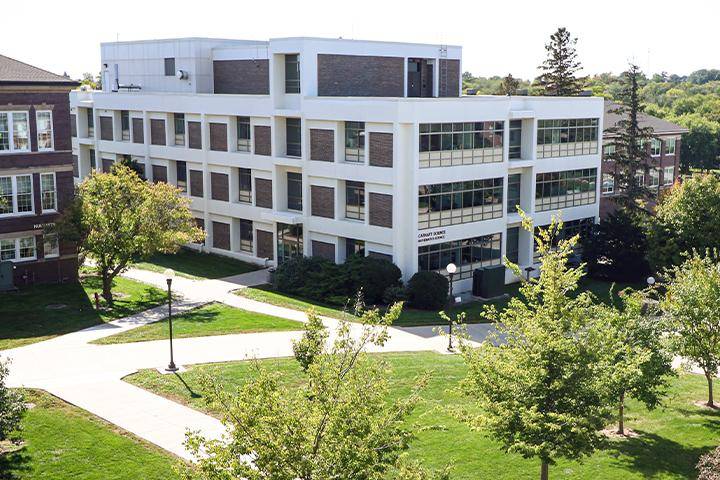
Students in this program will take courses in Carhart Science, home to WSC's math and science programs. Carhart Science features several labs for chemistry, biochemistry, anatomy, physiology, plant science, zoology, genetics, microbiology, physics, Earth science, fermentation, and science education. Additionally, there is a molecular-based student research lab, microscopy suite, a cadaver lab, and a cell culture facility.