
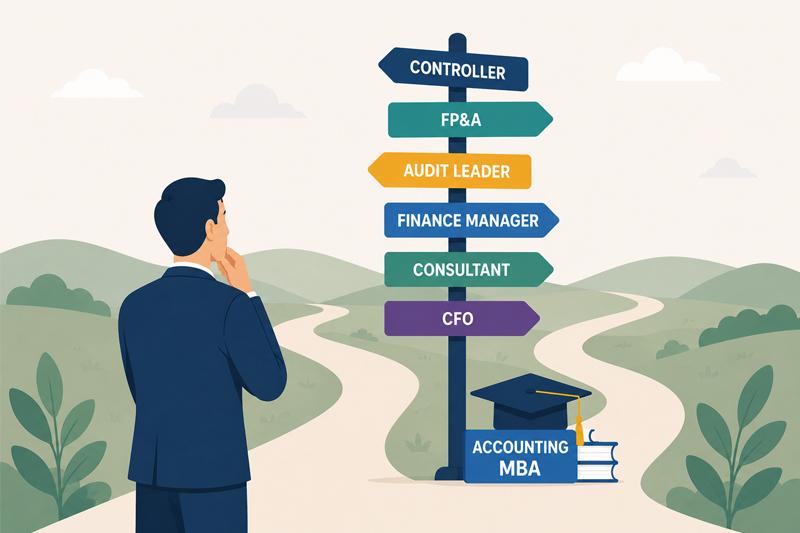
See where an Accounting MBA can take your career, from corporate accounting and FP&A to audit leadership, controller, finance management, and beyond.
An accounting degree is often linked to traditional accounting work, but it can open the door to a much broader set of careers in the field. Graduates may go on to steer financial strategy in FP&A, lead audit functions, or rise into controller and CFO positions. Reaching these roles usually takes more than technical know-how. It requires leadership skills and a strong professional network, along with a portfolio that demonstrates real business impact.
Why an MBA in Accounting Opens Multiple Career Paths
An MBA in Accounting builds advanced financial expertise while sharpening the leadership, analytical, and decision-making skills that employers value across industries and roles.
Moving Beyond Traditional Accounting Roles
Many graduates start out in accounting-focused positions, but an MBA can widen the range of accounting careers available from there. Employers increasingly look for professionals who can connect accounting expertise to larger organizational challenges, whether that means guiding a growth initiative, untangling an operational bottleneck, or advising leadership on a strategic decision.
Coursework in financial planning, corporate leadership, risk management, consulting, operations, and executive management gives graduates a foundation they can apply to multiple functions.
Combining Financial Expertise With Business Strategy
Accounting MBA programs pair technical financial training with coursework in management, strategy, economics, and organizational leadership. That combination prepares graduates to guide decisions and manage resources in ways that support long-term organizational success.
Common Career Paths for Accounting MBA Graduates
An accounting MBA can lead to a wide range of leadership and specialized finance roles in areas such as:
- Reporting
- Planning
- Analysis
- Auditing
- Consulting
- Executive leadership
The following career paths highlight how graduates apply accounting expertise, leadership experience, and management skills across corporate finance, public accounting, auditing, and executive leadership positions.
Becoming a Controller
Controllers oversee an organization's accounting operations to ensure financial integrity. They serve as key finance leaders responsible for accurate reporting, strong internal controls, regulatory compliance, and effective financial management.
Core Responsibilities of Controller Jobs
Controller jobs sit at the center of an organization’s day-to-day accounting operations, balancing hands-on oversight with longer-term financial planning. On any given day, a controller’s responsibilities might include:
- Supervise accounting teams
- Manage month-end and year-end close processes
- Oversee budgeting support
- Monitor financial performance
- Ensure accounting systems produce accurate and timely financial information
Managing Financial Reporting and Compliance
Major responsibilities involve preparing financial statements, maintaining compliance with accounting standards, coordinating audits, and strengthening internal controls. Controllers help organizations meet reporting requirements while minimizing financial and operational risks.
Typical Advancement Path to Controller Roles
Many controllers begin as staff accountants, auditors, or financial analysts before advancing to senior accountant, accounting manager, or assistant controller positions. An accounting MBA can help prepare professionals for progression into broader leadership responsibilities.
Exploring FP&A Careers
Financial planning and analysis (FP&A) focuses on evaluating performance, forecasting future results, and supporting strategic growth. These professionals, often working in financial analyst roles, help organizations translate financial data into informed business decisions.
What Professionals in FP&A Jobs Do
FP&A professionals turn raw financial data into a clear picture of how a business is performing and where it is headed next. On a typical day, that work involves:
- Analyzing financial results and identifying performance trends
- Evaluating key business metrics
- Creating reports for leadership
- Helping organizations understand profitability and efficiency
- Identifying risks and opportunities for improvement
Budgeting, Forecasting, and Business Planning
A significant portion of FP&A work involves developing budgets, creating financial forecasts, and modeling future scenarios. These activities help organizations allocate resources effectively while preparing for changing market conditions.
Working With Executives to Support Decision-Making
FP&A teams regularly collaborate with senior leaders to evaluate investments, growth initiatives, and operational strategies. They provide financial insights and scenario analyses to support decisions that influence organizational performance.
Audit Leadership and Internal Assurance Roles
Auditing and internal assurance focus on reviewing regulatory compliance and controls, as well as financial accuracy and operational effectiveness. These functions help organizations manage risk and support transparency and accountability.
Progressing From Auditor to Audit Manager
Many professionals begin as internal or external auditors before advancing into senior auditor and audit manager positions. Experience evaluating processes and controls helps build the expertise valued in leadership and governance roles.
Risk Management and Internal Controls
Audit leaders assess organizational risks, test internal controls, and recommend improvements to strengthen operations and organizational trust. Their work helps reduce compliance issues and improve the reliability of financial reporting.
Leadership Opportunities in Audit Functions
Experienced audit professionals may oversee audit departments, direct assurance programs, or lead enterprise risk initiatives. An accounting MBA can strengthen the management, communication, and strategic thinking skills needed for these positions.
Accounting Manager and Finance Manager Roles
Accounting managers and finance managers oversee critical financial activities while coordinating teams and organizational objectives. These positions blend technical expertise with operational oversight and leadership responsibilities.
Leading Accounting Teams and Processes
Accounting managers supervise accounting staff, review financial records, coordinate reporting activities, and ensure deadlines are met. They help maintain accuracy and accountability through an organization's accounting function.
Managing Financial Operations Across Departments
Finance managers work closely with multiple departments to monitor budgets, evaluate spending, and support financial objectives. Their cross-functional involvement helps align financial resources with broader business priorities.
Developing Staff and Improving Processes
Beyond overseeing transactions, accounting and finance managers are responsible for growing the people on their teams. That means coaching staff through more complex assignments, giving regular feedback, and building a culture where employees feel ready to take on new responsibilities.
This side of management often centers on:
- Mentoring and coaching employees
- Evaluating performance and identifying growth opportunities
- Identifying and implementing process improvements
- Supporting new technology and automation initiatives
When these efforts succeed, the payoff shows up in stronger team capabilities, leaner workflows, and financial operations that can scale smoothly as the organization grows.
Corporate Accounting Careers Beyond Traditional Reporting
Corporate accounting jobs offer specialized opportunities outside traditional financial reporting responsibilities. These roles combine accounting knowledge with operational insight, technology expertise, and collaboration across diverse business functions.
Revenue Accounting and Technical Accounting
Revenue and technical accountants interpret complex accounting standards, evaluate transactions, and ensure proper financial treatment. Their expertise helps organizations satisfy regulatory requirements while maintaining accurate and consistent reporting practices.
Financial Systems and Process Improvement
Professionals in these roles support the accounting technologies that keep financial data accurate and accessible, streamlining workflows and improving data quality along the way. Many also lead system implementations, automation initiatives, and process redesign projects aimed at improving operational efficiency.
Business Partnership and Decision Support Roles
Some accounting professionals work closely with operational leaders to analyze financial impacts, evaluate business initiatives, and provide actionable insights. Through collaboration, they help departments make more informed decisions.
Big Four Careers and Public Accounting Leadership
The Big Four accounting firms (Deloitte, PwC, EY, and KPMG) offer extensive experience in audit, tax, advisory, and consulting services. These organizations provide structured career development and exposure to diverse industries and clients.
Career Progression in Public Accounting Firms
Professionals often advance from associate to senior associate, manager, senior manager, and partner-level positions. Advancement typically depends on technical expertise and client management skills, as well as leadership capabilities and contributions to business development.
Transitioning From Public Accounting to Industry Roles
Public accounting experience is highly valued by corporate employers seeking strong financial and regulatory expertise. Many professionals move into controllership, finance leadership, internal audit, or strategic accounting positions within organizations.
The CFO Career Path
A Chief Financial Officer (CFO) serves as an organization's senior financial executive, overseeing financial strategy, performance, capital allocation, and risk management. They help align long-term business direction with financial strategy.
Building Experience Across Financial Functions
Future CFOs often gain experience in areas such as:
- Accounting
- Financial planning
- Treasury
- Auditing
- Controllership
- Operational finance
Exposure to multiple financial disciplines provides a broader understanding of organizational performance and priorities.
Developing Strategic and Executive Leadership Skills
Advancing to the CFO level requires much more than technical expertise; professionals must develop leadership, communication, negotiation, and strategic planning skills to effectively influence executives, boards, and stakeholders.
Expanding Influence Beyond Finance
Modern CFOs contribute to decisions involving growth initiatives, technology investments, operational improvements, and organizational strategy. Their role increasingly extends beyond financial oversight into enterprise-wide leadership and business transformation.
Skills That Accelerate Career Advancement
Advancing in accounting and finance careers involves developing a balanced skill set that combines technical knowledge with analytical ability, leadership capability, and strong interpersonal effectiveness across business environments.
Cross-Functional Collaboration Skills
Professionals who work effectively across departments gain broader visibility and impact. Collaboration with operations, marketing, and executive teams strengthens decision-making and helps align financial goals with organizational priorities.
Communication and Executive Presence
Clear communication of financial insights is essential for influencing leadership decisions. Strong executive presence enables professionals to present complex data confidently and translate analysis into actionable business recommendations.
Data Analysis and Business Intelligence
Modern finance roles require proficiency in analyzing large datasets, using financial systems, and interpreting business intelligence tools. These skills improve forecasting accuracy and support more informed strategic planning.
Leadership and Team Development
Effective leaders build strong teams by mentoring staff, delegating responsibilities, and fostering accountability. Developing teams while managing performance helps create high-performing finance and accounting departments capable of sustained success.
Building a Professional Portfolio That Demonstrates Impact
A strong professional portfolio helps accounting MBA graduates stand out by documenting measurable achievements, showcasing business impact, and illustrating how financial expertise translates into strategic operational improvements and organizational value.
Highlighting Process Improvements and Cost Savings
Candidates should document examples where they improved workflows, reduced inefficiencies, or achieved cost savings. Quantifying results demonstrates practical impact and shows an ability to drive measurable financial and operational gains.
Showcasing Financial Analysis and Strategic Projects
Effective portfolios include case studies of financial modeling, forecasting, investment analysis, or strategic planning projects. These examples highlight analytical thinking and the ability to support high-level business decisions.
Demonstrating Leadership Through Team and Project Results
Candidates can show leadership impact through managing teams, coordinating cross-functional projects, or mentoring colleagues. Evidence of successful collaboration and outcomes reflects readiness for managerial and senior finance roles.
Networking Strategies for Accounting and Finance Professionals
Networking plays a critical role in career progression for accounting MBA graduates. Strong professional relationships create access to opportunities, industry insights, and mentors who can help professionals accelerate their advancement in finance and accounting leadership.
Building Relationships Across Business Functions
Effective networking extends beyond finance teams. Building relationships with operations, sales, HR, and executive leadership increases visibility and strengthens collaboration while helping professionals understand how financial decisions influence broader organizational outcomes.
Leveraging Professional Associations and Industry Events
Professional organizations and conferences provide valuable opportunities to meet peers, learn industry trends, and connect with leaders. Active participation builds credibility and expands access to potential career opportunities and mentorship.
Using LinkedIn to Showcase Expertise and Growth
LinkedIn serves as a powerful platform for sharing achievements, publishing insights, and connecting with professionals in accounting and finance. Consistent engagement helps establish credibility and maintain long-term professional visibility.
Choosing the Career Path That Fits Your Interests
Selecting the right career path after an accounting MBA depends on personal strengths, work preferences, and long-term goals. Different roles emphasize technical accounting, strategic analysis, or leadership in varying degrees across finance functions.
Preference for Financial Reporting and Controls
Professionals who enjoy structure, accuracy, attention to detail, and compliance may gravitate toward controllership, audit, or corporate accounting roles. These paths emphasize financial integrity and regulatory standards that support organizational accountability and transparency.
Interest in Strategic Planning and Analysis
Those drawn to problem-solving and forward-looking analysis often prefer FP&A or corporate strategy roles. These positions focus on forecasting, scenario modeling, industry trends, historical performance, and translating financial data into insights that guide business growth and investment decisions.
Desire to Lead Teams and Organizational Initiatives
Individuals motivated by leadership and influence may pursue management or executive paths, such as an accounting manager, finance director, or CFO. These roles emphasize cross-functional coordination and help drive enterprise-wide initiatives.
An Accounting MBA Can Lead to Diverse Leadership Opportunities
An accounting MBA has the potential to open pathways across corporate finance, public accounting, audit leadership, FP&A, and executive management. From technical accounting roles to strategic decision-making positions, graduates can tailor careers to their strengths while progressing toward senior leadership.
Wayne State College's Online MBA in Accounting is designed to help professionals build the skills, flexibility, and credentials needed to advance in today's competitive financial landscape. If a future in accounting leadership interests you, we invite you to peruse our program page, learn about graduate admissions, request additional information, or apply today.
What career options open up after an Accounting MBA?
Graduates often move into controller jobs, accounting manager positions, FP&A and financial analyst roles, audit management, or consulting work. Some go on to specialize in corporate accounting jobs that blend financial reporting with technology and strategic projects.
What’s the difference between an MBA in Accounting and a standard accounting degree?
A standard undergraduate accounting degree centers on technical coursework, such as tax, auditing, and financial reporting. An MBA in Accounting builds on that foundation with business strategy, leadership, and operations training, preparing graduates for management and executive-level work rather than purely technical positions.
Does an Accounting MBA support a CFO career path?
It can. Most CFOs spend years building experience across accounting, treasury, financial planning, and operations before reaching the role. An MBA adds the strategic planning, communication, and leadership skills that boards and executive teams expect from a finance chief.
How much does networking matter for accounting careers?
A great deal. Relationships built through professional associations, industry events, and platforms like LinkedIn often lead to new opportunities and mentorship — advantages that are harder to come by through technical skill alone.
What belongs in a portfolio for accounting leadership roles?
Strong portfolios usually include examples of process improvements, cost savings, financial modeling or forecasting projects, and instances of leading teams or cross-functional initiatives. The goal is to show measurable impact rather than just a list of job duties.
Sources
-
https://fpacert.financialprofessionals.org/certification/what-is-fp-a
-
https://www.indeed.com/career-advice/finding-a-job/what-does-accounting-manager-do
-
https://www.indeed.com/career-advice/careers/what-does-a-finance-manager-do
-
https://www.indeed.com/career-advice/finding-a-job/how-to-become-corporate-accountant