
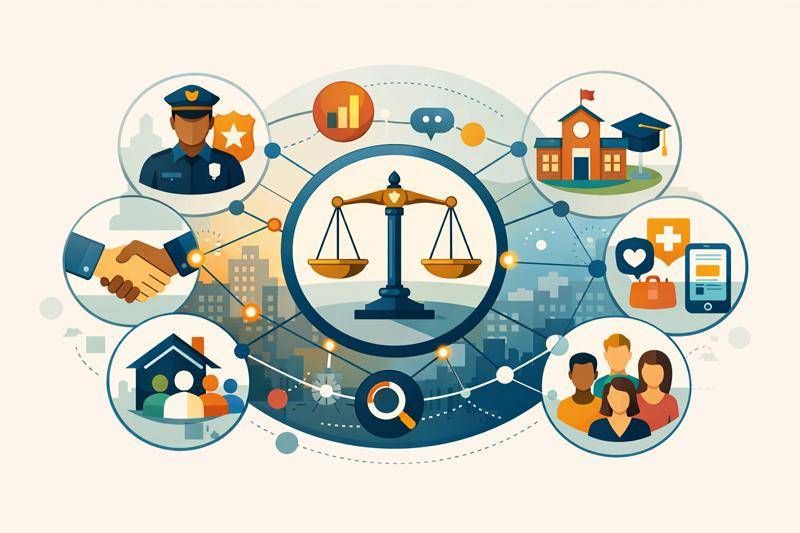
Justice leaders improve community outcomes by using data-driven strategies, evidence-based policing, and community partnerships to build trust, improve accountability, and strengthen public safety.
In an effort to transition from tactical policing to proactive operational management, street to strategy initiatives are taking center stage in criminal justice reform efforts. Public safety and emergency management leaders should not only be well-versed in these approaches, but they also should possess the data analysis and communication skills necessary to effectively implement them.
Why “street to strategy” leadership matters
Modern criminal justice leadership requires professionals to step away from reactionary measures and, instead, implement evidence-based proactive strategies that improve transparency, build trust, and open the lines of communication between communities and law enforcement. Collaboration plays a key role in reducing crime, improving public safety, and increasing transparency as well as accountability in the criminal justice system.
The modern justice leader’s operating model
The leadership frameworks in criminal justice have been shifting in recent years, moving away from an autocratic leadership model to a service-oriented policing framework. Effective leadership development programs are necessary to help criminal justice managers and administrators hone the core competencies necessary to lead in complex, multilevel, and evolving organizations.
Data-informed leadership that improves outcomes
Data unlocks the key to effective criminal justice leadership in today's modern communities. By employing data-driven strategies and relying on an evidence-based approach to proactive crime prevention, criminal justice administrators and managers can improve outcomes on multiple levels.
Metrics that matter beyond arrest counts
Actionable insights within the criminal justice system are derived from key metrics. Crime analysis metrics provide both leaders and members of the public with the evidence-based information that they need to improve safety in local communities. By looking at valuable metrics, such as calls for service, reported crime, use of force incidents, and civilian complaints, leaders can begin to understand the full scope of law enforcement activity in a community.
Evidence-based approaches and problem-oriented policing
Today's crime reduction strategies require a proactive approach, which is enabled by evidence-based policing. Problem-oriented policing (POP) is one of the proactive approaches that is taking center stage in today's complex climate. POP is a strategic approach that works to reduce crime by addressing the underlying factors that may increase the risk of criminal behavior in an individual.
Using analytics with guardrails
Data analysis is a powerful law enforcement tool, but leaders need to approach it with caution. Relying on algorithms that reduce bias and prioritize privacy and accuracy when generating insights is vitally important to successfully developing effective and fair evidence-based policing strategies.
Partnerships that multiply impact
Proactive community policing efforts depend heavily on strategic partnerships within the local area. These valuable partnerships help agencies bridge the equity gap, improve accessibility, and increase trust in law enforcement. Partnerships must exist between law enforcement officers, government leaders, community organizations, and members of the public to advance criminal justice reform and public safety efforts.
Co-responders and behavioral health collaborations
Law enforcement officers are increasingly being called to help individuals who are suffering from mental health disorders or whose behavior is influenced by a mental health condition. Co-response models allow law enforcement officers to respond to calls alongside a mental health professional or specially trained law enforcement agent to address issues that may be exacerbated by mental health, such as homelessness.
Schools, housing, and youth-serving organizations
Partnerships with schools and other youth-serving organizations allow law enforcement officers to embed themselves into the community and begin building trust from the ground up. School resource officers have become critical partners in the effort to improve safety on campus and bolster police community relations among young people.
Courts, corrections, and reentry networks
Reentry networks are evidence-based systems that are designed to support individuals who have been incarcerated and are transitioning back into mainstream society. The National Reentry Resource Center is considered the primary source for reentry information and support services, and it emphasizes the importance of housing, affordability, and collaborative support services in the effort to help individuals acclimate to society once again.
Community-based organizations and faith leaders
Community-based and faith-based organizations serve as an essential link between law enforcement officers and the community at large. Partnerships with these active and vibrant community organizations can help build trust in law enforcement and diffuse volatile situations in the community.
Policy and practice: turning values into daily behavior
Relying on data-driven initiatives, such as CompStat, to create evidence-based policies within law enforcement is only the first step. Next, a link must be created between policy and practice, enabling law enforcement leaders and officers to adopt a values-based approach to community policing.
Procedural justice in the field
Procedural justice refers to the concept of treating individuals in a community fairly and justly when addressing concerns or disputes. When it comes to building trust in law enforcement and improving community engagement in policing, actionable procedural justice is essential. The core principles of procedural justice are treating citizens fairly and with respect, displaying trustworthy motives through evidence-based policing, working to reduce implicit bias, and providing community members with an opportunity to use their voice and share their experiences.
Training that changes performance
When it comes to policy development and implementation, evidence-based training is key to successfully implementing community policing initiatives. Specialized training that emphasizes the importance of procedural justice helps to lower arrests, improve violent crime prevention efforts, increase neighborhood safety, and strengthen trust in the community.
Accountability systems that improve, not just punish
Accountability systems must exist within law enforcement agencies that encourage transparency and build trust among the public. Involving both internal and external measures, these accountability systems should support law enforcement officers and encourage them to improve their policing strategies, rather than simply punish them for poor decision-making.
The leadership levers: culture, incentives, and communication
Law enforcement leadership has a significant impact on organizational culture, with the leadership pipeline directly influencing the values of the organization and the actions of law enforcement officers. Creating a values-based culture that prioritizes accountability, transparency, trust, and communication can improve the outcomes of criminal justice reform efforts within a law enforcement agency.
Culture and standards
The standards that a law enforcement organization adopts determine its overall culture. According to the FBI, building the right culture begins with service-based leadership, in which managers and administrators model the values of the organization as a whole. From there, culture is developed through a targeted mission statement and intentional training that supports officers as they work to adopt organizational values.
Supervisors as the strategy layer
Supervisors often serve as a liaison between law enforcement administrators and law enforcement officers. They play a key role in translating organizational policy, modeling agency values, and connecting policy development and implementation. In most agencies, supervisors become the role models of the organization, showcasing how officers should address their peers and community members, and providing guidance for community policing.
Strategic communication and community transparency
Effective communication that is strategic, proactive, and transparent remains crucial in navigating the complexities of the modern environment. Communication efforts not only build trust in law enforcement, but they also allow officers to respond more swiftly, effectively, and fairly to calls within the community. Strategic communication in law enforcement agencies serves as a vital link between policy and action.
Operational excellence that builds trust
Law enforcement managers and administrators are responsible not only for overseeing criminal justice reform and community policing efforts within their organizations, but also for improving operational excellence as a whole. Through targeted, streamlined efforts, law enforcement managers can create a culture of accountability, transparency, and trust.
Operational excellence in law enforcement involves defining standards, improving accountability, and enabling consistency. Through standards, accountability, and consistency, they can maximize the use of organizational resources, provide law enforcement officers with internal and external support, and create a culture of continuous improvement.
Implementation playbook: from idea to sustainable change
Knowing that evidence-based policing will help strengthen your law enforcement agency and improve community outcomes is the first step. Next, you must start taking the steps necessary to adapt values, improve organizational policies, and implement community policing efforts.
This guide can help you get started:
Start with one priority outcome
Criminal justice reform can seem so overwhelming that it's difficult to get started. Instead of trying to make every change possible within your organization, identify one priority outcome — such as fewer arrests or reduced number of uses of force incidents in a particular neighborhood — and develop a strategic initiative that will yield targeted results.
Run a 90-day pilot with partners
Create a collaborative pilot program with partners in the local community, such as educators, faith-based organizations, or government leaders. Once the scope of the pilot program has been determined and agreed upon, run a trial run for a specific period. This allows you to monitor results in real-time and determine if your strategy needs to be adapted.
Evaluate, adapt, and scale
After the pilot program has been completed, you and your team should perform data analysis to evaluate key metrics and adapt the initiative accordingly. Once you have a better understanding of what worked well — and what didn't — you can scale the program for full release and use it as a framework for future goals.
Common pitfalls and how leaders avoid them
Common pitfalls in evidence-based policing include:
- Lack of high-quality data
- Overreliance on biased data
- Confirmation bias and tunnel vision among the police force
- Inadequate resources and lack of training
By understanding the most common mistakes in implementing evidence-based policing strategies, law enforcement managers and administrators can actively work to improve training efforts and reduce the impact of implicit bias within their agencies. Transparent and proactive communication is crucial to the success of these efforts.
Learn about the powerful role of evidence-based policing strategies at Wayne State College
In public safety management and administration, data analysis and evidence-based policing are expected to play a significant part in operational strategies in the years to come. The online master's degree in Criminal Justice Administration and Management (MSOM) at Wayne State College prepares graduates for leadership roles in the criminal justice field through industry-aligned coursework that promotes ethical decision-making, effective communication, and data analysis.
Request more information about our MSOM program, learn more about MSOM program admissions, and apply today.
FAQs: how justice leaders improve community outcomes
1) What does data-informed leadership mean in justice work?
It means using reliable metrics to understand harm patterns, choose interventions, and measure whether strategies reduce harm and improve service, while maintaining transparency and privacy guardrails.
2) How do partnerships actually reduce crime or harm?
Partners expand the toolkit beyond enforcement, connecting people to services, improving prevention, and addressing root drivers like housing instability, behavioral health needs, and reentry barriers.
3) What metrics best reflect community outcomes?
A balanced set might include repeat calls for service, victim follow-through, clearance quality, response equity, complaint trends, and community sentiment, not just arrest totals.
4) How can leaders build trust while enforcing the law?
Leaders can implement procedural justice practices, such as clear communication, consistent treatment, and transparency. This naturally improves legitimacy, but operational reliability and follow-through also matter.
5) What is the role of supervisors in community outcomes?
Supervisors translate policy into daily decisions. Coaching, accountability, and reinforcement of standards are the strongest levers for consistent field behavior.
6) How do agencies avoid bias when using analytics?
Agencies can use high-quality data definitions, audit for disparate impact, add human review, communicate methods, and include community oversight where appropriate to avoid data bias.
7) What is a realistic first step for a new justice leader?
Pick one outcome (e.g., reduce repeat crisis calls), build a partner pilot, set clear metrics, and run a 90-day cycle with evaluation and public reporting.
Sources
- https://www.wsc.edu/criminal-justice-masters-degree
- https://www.urban.org/sites/default/files/2023-03/Community%20Engagement%20Strategies%20to%20Advance%20Justice%20Reform.pdf
- https://www.americanprogress.org/article/delivering-accountability-a-plan-to-stop-crime-in-our-communities/
- https://visionzeronetwork.org/restorative-justice-strategies-for-safe-streets/
- https://smartjustice.org/podcast/a-shot-at-hope/proof-in-the-numbers-tracking-change-to-save-lives
- https://leb.fbi.gov/articles/featured-articles/improving-police-leadership-development
- https://justicecounts.csgjusticecenter.org/metrics/
- https://www.ebsco.com/research-starters/social-sciences-and-humanities/problem-oriented-policing-pop
- https://www.theiacp.org/topics/community-police-engagement
- https://leb.fbi.gov/articles/featured-articles/co-response-models-in-policing
- https://www.nassp.org/school-resource-officers-and-law-enforcement-in-schools/
- https://nationalreentryresourcecenter.org/
- https://www.nlc.org/article/2017/04/27/how-law-enforcement-and-the-faith-community-can-work-together-for-cities/
- https://www.ebsco.com/research-starters/social-sciences-and-humanities/compstat
- https://www.soundthinking.com/blog/what-are-the-core-principles-of-procedural-justice/
- https://www.policinginstitute.org/press-releases/study-intensive-specialized-training-of-police-officers-leads-to-reduced-crime-fewer-arrests-and-more-positive-interactions-and-community-evaluations/
- https://leb.fbi.gov/articles/perspective/perspective-building-the-right-culture-for-the-organization
- https://www.police1.com/chiefs-sheriffs/achieving-operational-excellence-through-s-a-c