
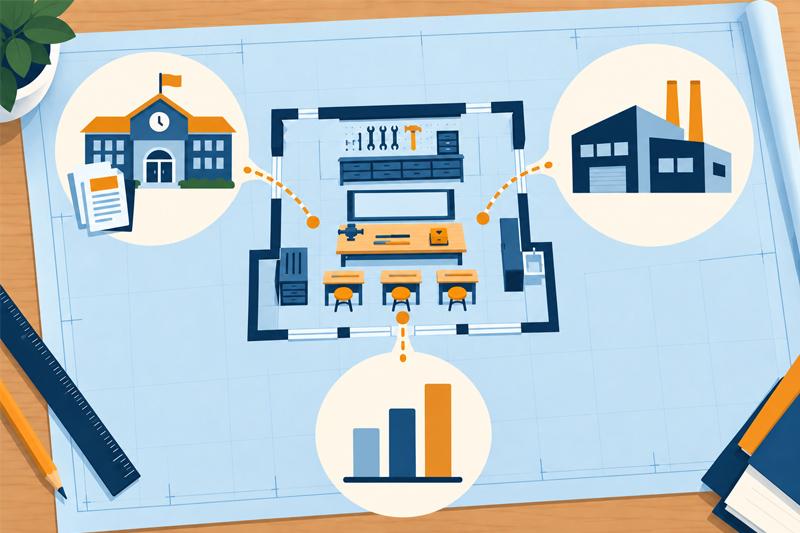
Graduate study can help CTE educators strengthen curriculum, build industry partnerships, improve safety, and use research to guide program decisions.
Career and technical education prepares students for workplaces that rarely stand still. As equipment and employer expectations change, safety practices evolve as well. Meanwhile, every new group of learners brings a different mix of experience, interests, and goals.
Graduate study gives CTE educators space to look beyond immediate classroom demands and examine how an entire program functions. Through that broader view, they can refine instruction, strengthen partnerships, and use evidence to guide improvement.
Why Career and Technical Education Requires Advanced Leadership
Positioned between education and employment, CTE must respond to changes in both. Technical expertise remains essential, but leading a strong program also requires sound decisions about instruction and long-term direction.
An educator may be asked to revise a CTE curriculum or determine whether new equipment belongs in a program. At other times, the priority may be strengthening industry partnerships so classroom preparation remains relevant to employers without becoming narrowly tied to one company's practices.
Responsibilities of this scale extend beyond a single class. Graduate study can help educators evaluate instructional decisions through research and develop the leadership perspective needed for programwide improvement. One option is Wayne State College's online Master of Science in Education in Curriculum and Instruction with a Skilled and Technical Sciences Education focus.
What Does Graduate Study in Career and Technical Education Cover?
By stepping back from daily routines, graduate students can investigate why programs are designed in particular ways and how those choices affect learners. Coursework typically connects educational theory with challenges already familiar to technical instructors.
Advanced Curriculum and Instructional Design
Technical mastery does not automatically translate into effective curriculum design. Educators must determine how skills build on one another, what foundational knowledge students need, and when learners are ready for more complex work.
Advanced coursework can connect instructional theory with the realities of a lab or shop. Rather than adding material whenever technology changes, educators can shape a CTE curriculum around deliberate outcomes and a coherent sequence.
Leadership, Program Administration, and Policy
With experience, CTE educators may assume responsibility for program budgets or instructor coordination. Some also contribute to policy, facilities planning, and broader decisions about how a program should develop.
Understanding those systems can make program advocacy more persuasive. When staffing, equipment, or facility decisions arise, leaders are better prepared to explain the educational need and its connection to student outcomes.
Research Methods and Data-Informed Decision-Making
Graduate-level research training offers a structured way to investigate questions that emerge from everyday teaching. It replaces impressions with a process for gathering evidence and interpreting results.
Instead of assuming that a new approach works, educators can identify useful measures and examine what the data show. Wayne State's curriculum includes Introduction to Educational Research and Design, which supports this type of inquiry.
Strengthening CTE Curriculum Through Advanced Study
A strong curriculum goes beyond a checklist of technical tasks. While preparing students for current work, it should also establish the knowledge and habits they will need to adapt as their field changes.
Aligning Courses With Industry Competencies
Employers are often the first to recognize when classroom preparation begins to drift from workplace expectations. Their perspective can help educators identify gaps before those gaps become entrenched.
Through strong industry partnerships, programs can gather timely input about occupational practices and employability expectations. The Association for Career and Technical Education notes that business and industry partners can contribute to curriculum, work-based experiences, equipment decisions, and program improvement.
Employer feedback is most useful when considered alongside program goals rather than treated as a list of instructions. As ACTE explains in its guidance on partnerships and advisory boards, educators retain responsibility for balancing immediate workforce needs with broader, longer-term preparation.
Connecting Technical Skills With Academic Learning
Technical instruction becomes more durable when students understand the principles behind a task. Connecting occupational practice with academic learning helps them transfer what they know to unfamiliar situations.
Accurate manufacturing work, for example, depends on measurement and mathematical reasoning. In another field, clear documentation may be equally important. Graduate study can help educators build these connections into instruction without allowing the supporting academics to overshadow technical application.
Updating Curriculum as Technology and Workplaces Change
A functioning lab does not guarantee a current curriculum. Even when equipment remains usable, changes in tools and workplace processes may alter what students need to learn.
Monitoring the field is only the first step; educators must also decide which developments belong in instruction. Coursework on current trends and developments in technology education can provide a framework for evaluating new practices without chasing every short-lived change.
Designing Inclusive Pathways for Diverse Learners
Students enter technical programs from different starting points. Some already feel comfortable with tools and equipment, whereas others are encountering the field for the first time.
Thoughtful design gives both groups room to progress. Strong foundational instruction can support beginners, while flexible assignments or advanced applications keep experienced learners moving forward. Along the way, educators can identify requirements that create barriers without adding educational value.
Creating Safer and More Effective Technical Learning Environments
In CTE, safety cannot be separated from instructional design. The physical environment, teaching sequence, and assessment plan all affect how students learn to work responsibly.
Evaluating Laboratory and Shop Safety
Beyond meeting state or facility requirements, educators should consider how learners move through a space and interact with equipment. Studying lab safety practices, facilities, and equipment can help them recognize hazards, evaluate procedures, and make defensible classroom decisions.
Building Safety Into Curriculum and Assessment
Safety becomes more meaningful when it is embedded in everyday instruction. Practical assessments should require students to demonstrate safe procedures as part of competent performance, rather than treating safety as a separate list of rules.
Preparing Students for Workplace Procedures and Expectations
A school lab can also introduce the routines expected in professional settings. Following a lockout procedure or documenting an inspection teaches students that responsible work includes consistent processes, not technical output alone.
Expanding Work-Based Learning Opportunities
Through work-based learning, students can test classroom knowledge in authentic or simulated work environments. The experience also helps them understand how technical ability fits within a larger organization.
Internships, Apprenticeships, and Cooperative Education
Internships and apprenticeships place students alongside experienced workers while they develop occupational skills. Cooperative education more formally connects academic study with structured employment related to a student’s program. Although each model is structured differently, all require clear learning goals and appropriate oversight.
Job Shadowing and Employer-Led Projects
Job shadowing offers a relatively brief view of an occupation and its setting. When placements are limited, employer-led projects can bring authentic constraints and expectations into the classroom without requiring every student to work on site.
Simulations and School-Based Enterprises
Simulations recreate workplace decisions in a controlled environment, allowing students to practice without encountering every risk of an active job site.
School-based enterprises take a different approach by serving real customers or managing actual operations under educational supervision. Because the work has consequences, students can see how quality and reliability affect other people.
Together, employer-connected experiences and educator-designed simulations can expand access to career learning. The strongest choice depends on the intended outcome, available partners, and level of student readiness.
Evaluating Work-Based Learning Quality
An off-campus placement is not automatically a strong learning experience. Quality depends on whether students receive meaningful responsibilities and whether those duties connect to program outcomes. Feedback from supervisors can then show what students learned and where further preparation is needed.
Aligning CTE Programs With Workforce Needs
Occupational growth matters, but it is only one indicator of workforce need. Program decisions should also account for local conditions and the durability of the skills being taught.
Using Labor Market and Employer Feedback
National labor-market information from sources such as the U.S. Bureau of Labor Statistics establishes broad context. Local employers can add details about regional hiring patterns, emerging processes, and difficult-to-fill skill needs.
Considered together, these sources help educators judge whether a program prepares students for realistic opportunities in the surrounding region. Conflicting signals may also point to questions that require additional research.
Distinguishing Short-Term Trends From Lasting Skills
Not every new tool deserves a separate course. Before revising instruction, educators must distinguish temporary enthusiasm around a technology from competencies likely to remain useful after the software or equipment changes.
Graduate study can strengthen this judgment by introducing systematic ways to evaluate trends. Decisions then rest on evidence and program priorities instead of pressure to react quickly.
Preparing Students for Transferable and Technical Competencies
Technical ability may help someone enter a field, but continued success often depends on troubleshooting and clear communication. Students also need to recognize when a familiar process no longer fits the situation.
A balanced program builds occupational expertise while giving learners opportunities to solve unfamiliar problems. That combination supports adaptability when technologies, procedures, or job responsibilities change.
Using Applied Research to Improve CTE Programs
Research does not have to remain in academic journals. Within career and technical education, it can begin with a recurring classroom problem and lead directly to a practical improvement.
Identifying Problems of Practice
Perhaps students repeatedly struggle with one part of a technical assessment. In another program, employer feedback may indicate that graduates need stronger preparation for a particular process.
Either pattern can become a focused research question. Defining the problem carefully helps an educator select evidence that can actually clarify it.
Conducting Action Research in Technical Classrooms
Action research provides a structured way to test an instructional change within the educator's own setting. Because the investigation is grounded in local practice, its findings can inform immediate decisions.
An instructor might introduce a new simulation and compare student performance before and after the change. Classroom observations could add context, helping explain why results improved, declined, or remained the same.
Turning Research Findings Into Program Improvements
Research becomes valuable when findings influence practice. The conclusion should lead to a decision or a more precise question, rather than ending with the data.
Results may support a course redesign or reveal a need for different equipment. Just as importantly, they may show that a proposed change offers too little benefit to justify its cost.
Measuring Student and Program Outcomes
Program evaluation considers whether students benefit during instruction and after it ends. No single measure can answer that question, so educators need evidence that reflects both learning and longer-term outcomes.
Technical Skill Attainment and Credential Completion
Technical assessments and industry credentials document specific forms of attainment. Viewed over time, the results can reveal where students consistently perform well and where the curriculum may need attention.
Student Retention, Completion, and Placement
Enrollment indicates interest, while retention and completion data reveal whether students remain in a pathway. Placement information extends the inquiry beyond graduation by showing whether learners enter work related to their preparation.
Employer and Graduate Feedback
Graduates can describe where their coursework matched workplace expectations and where they felt less prepared. Employers provide another view of the same transition. When patterns appear across both groups, educators gain a clearer basis for improvement.
Equity and Access Across CTE Pathways
Program-level data can also reveal who enters a pathway and who completes it. When a group of students leaves at a disproportionate rate, educators can investigate where barriers arise instead of assuming that the program serves everyone equally well.
How Graduate Study Supports Grant Writing and Program Development
Even a strong idea needs a clear case for funding. Graduate coursework can help educators define a need, support it with evidence, and connect a proposed expense to educational priorities.
A persuasive proposal also explains what success would look like. Rather than requesting a new lab solely because existing equipment is old, educators can describe the outcomes the investment should support and how those outcomes will be measured.
Once funding is awarded, evaluation closes the loop. Evidence of the investment's results can guide future decisions and strengthen accountability to funders or institutional leaders.
Applying Graduate Learning to Real CTE Challenges
Graduate learning has the greatest value when it can be applied to genuine CTE challenges. Assignments grounded in current work may produce ideas that educators can refine and use in their programs.
Redesigning an Outdated Technical Course
Comparing course competencies with current industry expectations may reveal where an older technical course has fallen behind. Educators can then redesign activities around the most consequential gaps instead of replacing content indiscriminately.
Launching a New Work-Based Learning Partnership
Employer input can help define a work-based learning experience with clear responsibilities for students and supervisors. Expectations for feedback and assessment should be established before the placement begins.
Improving Safety Procedures in a Lab or Shop
Incident patterns and observations of how learners use a lab can expose weaknesses in existing procedures. After making a targeted change, educators can assess whether behavior and safety outcomes improve.
Evaluating Whether a Program Meets Workforce Demand
Labor-market evidence, enrollment patterns, and input from industry partnerships can clarify whether demand supports a program's current size and direction. Together, those sources may justify a curriculum adjustment or a closer study of recruitment.
Who May Benefit From Advanced Study in CTE?
Advanced study may appeal to classroom instructors who want to improve teaching without leaving it. Its value can also extend to educators responsible for partnerships, program coordination, or broader instructional leadership.
A work-based learning coordinator might use graduate study to strengthen employer collaboration. For a program director, deeper preparation in evaluation and curriculum planning may be more relevant. Industry professionals who have already transitioned into teaching can also learn how to translate occupational expertise into instruction.
For educators already certified in the content area, Wayne State College's Skilled and Technical Sciences Education MSE provides a fully online, 36-credit option within Curriculum and Instruction. Its focus combines advanced education coursework with specialized study in skilled and technical sciences.
Turning Technical Expertise Into Broader Educational Impact
Industry knowledge provides the starting point. Graduate study can help educators examine how that expertise is taught, how programs respond to change, and whether students achieve the intended outcomes.
Wayne State College's online Master of Science in Education in Curriculum and Instruction with a Skilled and Technical Sciences Education focus combines a curriculum and instruction core with specialized coursework. Educators interested in strengthening their work in career and technical education can review the program structure and admission information before deciding whether it fits their goals.
FAQs
Can graduate study help a CTE teacher improve an existing program without changing careers?
Yes. Graduate study can strengthen an educator's work in a current classroom or program without requiring a career change. Coursework may inform a course revision, a new instructional method, safer laboratory procedures, or a more useful approach to outcome evaluation. Experienced teachers can apply what they learn where they already work.
How can applied research benefit a technical education classroom?
Applied research turns a local instructional concern into a question that can be examined systematically. An educator might investigate a difficult technical competency or compare safety performance before and after a simulation. Findings can support more informed classroom and program decisions.
How can CTE programs balance current employer needs with long-term student preparation?
Employer input can identify immediate needs, but it should be considered alongside labor-market research and graduate outcomes. Alongside occupation-specific competencies, students need preparation that remains useful when tools and processes change. This balance helps a program serve both near-term employment and continued development.
Why should CTE educators evaluate outcomes beyond certification pass rates?
Credential results show one part of program performance. Completion and technical-skill data provide additional context, while graduate or employer feedback can reveal how preparation transfers to the workplace. Examining access and outcomes across learner groups may also uncover barriers that an overall pass rate hides.
Sources
https://www.wsc.edu/sts-education-masters-degree
https://www.wsc.edu/curriculum-instruction-masters-degree
https://www.acteonline.org/cte-101/partnerships-and-advisory-boards