
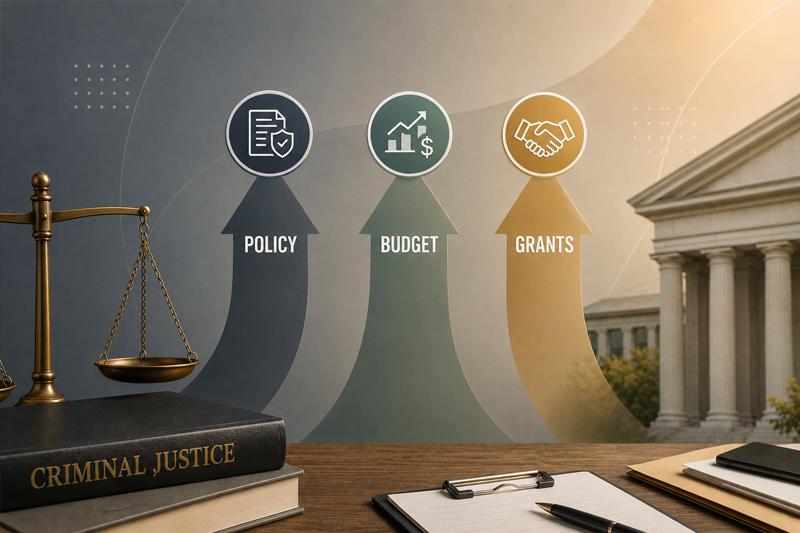
Explore how criminal justice leaders develop policy, manage budgets, secure grants, and make evidence-based decisions for public safety.
Growing demands for transparency and accountability are reshaping the criminal justice field, pushing leaders to make more informed and balanced decisions about policy, spending, and beyond.
Serving in a leadership or management role in this dynamic field requires a solid grasp of policy analysis, budgeting, evidence-based decision-making, and organizational leadership. Wayne State College's Master of Science in Criminal Justice Administration and Management program prepares professionals for the unique challenges and opportunities this line of work presents.
Why Justice Leaders Need More Than Operational Expertise
Today's criminal justice landscape demands leaders whose skill sets extend well past day-to-day operations. Strategic planning, public policy fluency, and budgeting expertise round out the toolkit leaders need to oversee programs confidently and implement reforms that strengthen public safety outcomes.
The Expanding Scope of Criminal Justice Leadership
The scope of criminal justice leadership has shifted considerably in recent years, shaped by new public expectations and technological advancements (such as body-worn cameras). Leading a modern department now calls for a broader set of competencies, from policy fluency to fiscal management, alongside operational skills.
Balancing Public Safety Goals With Fiscal Responsibility
While much about the field continues to evolve, tight budgetary constraints have remained a constant for public safety agencies. Justice leaders must weigh these constraints carefully when making decisions about staffing, training, and technology investments, since each choice carries direct implications for public safety outcomes.
Understanding the Relationship Between Policy, Budgeting, and Funding
Policy, budgeting, and funding are inseparable in criminal justice. Policies set organizational priorities and guide decision-making, while budgets determine whether those policies can actually be carried out. To stretch limited resources further, many departments also turn to grants and external funding.
Understanding how these three elements influence one another allows capable justice leaders to keep their departments running efficiently.
Policy Writing Fundamentals for Justice Leaders
Crafting a new policy (or revising an existing one) generally involves the following steps:
- Identifying the problem: The policy should clearly outline what it needs to solve, with close attention to desired outcomes and the populations it affects.
- Writing clear and actionable policy language: The policy should define responsibilities, outline procedures, and clarify any reporting requirements.
- Aligning policies with laws, regulations, and best practices: This should pay particular attention to federal, state, and local requirements.
Building Evidence Into Policy Development
Successful justice policies typically weave in evidence-based principles and community input from the start, and they get adjusted over time so the populations they serve continue to benefit. This requires justice leaders to:
- Apply evidence-based policing principles, as policies grounded in proven research tend to gain broader support and improve community outcomes.
- Seek input from community members and other stakeholders, including local government officials and criminal justice partners.
- Monitor performance indicators over time, tracking metrics that range from response times and crime rates to recidivism and community satisfaction with law enforcement.
Budgeting Basics for Public Safety Leaders
Beyond writing clear, evidence-based policies, modern justice leaders also carry the responsibility of being fiscally knowledgeable. That may involve:
- Understanding operating vs. capital budgets: Leaders should recognize the difference between operating budgets, which cover day-to-day expenses, and capital budgets, which fund long-term investments such as facilities or technology upgrades.
- Prioritizing resources with limited funding: Effective leaders learn to allocate limited financial resources where they will have the greatest impact, balancing immediate needs with long-term priorities.
- Connecting budget requests to strategic goals: Strong budget proposals clearly demonstrate how requested funding supports organizational objectives, allowing stakeholders to see the value of the investment.
How Grant Funding Supports Public Safety Initiatives
Grants play a critical role in supporting public safety programs and initiatives, particularly as departments juggle limited budgets alongside growing demands for transparency and accountability. Fortunately, there are many different types of government grants for law enforcement agencies to explore, including both federal funding streams and state and local opportunities.
Department of Justice Grants
Department of Justice (DOJ) grants offer some of the most substantial funding opportunities for law enforcement agencies. With billions of dollars distributed annually, justice leaders can use the Justice Grants System (JustGrants) to explore and apply for opportunities that fit their department's needs.
Homeland Security Grants
Homeland Security grants represent another major funding stream, offered through the Department of Homeland Security to support programs such as emergency preparedness and disaster response. According to the FEMA website, more than $1 billion in funding was available in 2025 alone.
Community Policing and Criminal Justice Grants
Criminal justice grants supporting community policing and related initiatives may be available at the federal, state, or local level. These funds typically create opportunities for:
- Violence reduction programs, such as intervention initiatives targeting high-risk individuals and neighborhoods
- Community engagement efforts that strengthen trust and collaboration between residents and law enforcement
- Youth intervention programs designed to build positive relationships and reduce repeat contact with the justice system
Finding Grant Opportunities
Knowing how to navigate different funding portals and identify relevant opportunities puts criminal justice leaders in a stronger position to secure the resources their departments need for new programs and policy initiatives.
Navigating Grants.gov and Federal Funding Databases
Grants.gov remains one of the most widely used portals for agency-specific funding, consolidating opportunities from across federal agencies into a single searchable database. Beyond monitoring the portal regularly, justice leaders should establish clear departmental processes for determining eligibility and assigning responsibility for applications.
Identifying State, Local, and Foundation Grant Opportunities
Beyond federal grants, funding may come from state agencies, community organizations, and private foundations. Diversifying funding sources helps departments avoid over-reliance on any single stream, which can improve long-term sustainability.
Grant Proposal Writing Essentials
Students pursuing a master's degree in criminal justice management or a related field should come away with hands-on experience researching and applying for grants. That includes mastering the basics of grant proposal writing, such as:
- Defining the problem statement, which should describe the issue clearly while presenting any relevant supporting data.
- Building a realistic project plan that includes goals, timelines, and key performance metrics.
- Developing a competitive budget narrative that details exactly how funds will be allocated.
- Demonstrating community impact and sustainability with expected outcomes, long-term benefits, and a clear plan for continuing the work after funding ends.
What Funders Look For in Successful Proposals
Once application deadlines pass, funders review every application closely to narrow the field. Top qualities they look for include:
- Clear objectives and measurable outcomes
- Data-driven justification for funding requests
- Organizational readiness and capacity
A strong funding proposal begins with clearly defined objectives and measurable outcomes that explain what the organization hopes to accomplish and how success will be evaluated. Rather than making broad requests for financial support, effective proposals outline specific goals and identify metrics that can demonstrate progress and impact.
Funding requests are also more compelling when they are supported by data, such as community needs assessments, program outcomes, or research findings. Finally, organizations must demonstrate readiness and capacity by showing they have the leadership, staffing, and resources needed to manage funding responsibly.
Examples of Public Safety Projects That Commonly Receive Funding
While there are many possibilities for grant funding in law enforcement, some categories of public safety projects consistently attract more funding than others. These include:
- Technology and equipment modernization projects, such as upgrades to digital evidence platforms and cybersecurity improvements.
- Officer wellness and workforce development initiatives, including peer support programs and mental health services.
- Community engagement and violence prevention, including youth outreach and community partnerships.
- Training and evidence-based policing programs, especially as they relate to leadership development and crisis intervention.
Managing Grants After Funding Is Awarded
Securing a grant is only half the job. Once funding is awarded, justice leaders carry an ongoing responsibility to ensure funds are used appropriately and in compliance with the terms of the award.
Tracking Spending and Compliance Requirements
Leaders are typically responsible for maintaining meticulous documentation of fund spending and meeting every reporting requirement tied to the grant. Falling short on either front can expose departments to legal and financial risk.
Measuring Outcomes and Reporting Results
Many grants come with performance reporting requirements attached as a condition of funding. These reports help both funders and departments assess whether funded activities delivered the outcomes outlined in the original proposal.
Preparing for Audits and Grant Closeout
Because departments can be audited at any point before a grant closes out, justice leaders should stay audit-ready year-round. Organized financial documentation, performance reports, procedural records, and other supporting materials should also remain on hand.
Common Mistakes Justice Leaders Make With Grants and Budgets
Even experienced justice leaders can run into challenges when managing grant funding alongside limited department budgets. These include neglecting compliance requirements after funding is awarded, relying on weak performance metrics, or failing to align funding requests with specific strategic priorities. Recognizing common pitfalls ahead of time can help leaders avoid them.
Building Long-Term Funding and Policy Strategies
The justice leaders who see the most success with policy, budgeting, and funding tend to take a long-term view rather than chasing isolated grants. That means building integrated strategies that align funding and budgetary needs with organizational goals and policy priorities.
This kind of comprehensive approach builds the consistency and sustainability needed for long-term success, rather than short-lived gains.
Effective Leadership Requires Policy, Budget, and Funding Expertise
Modern justice leaders are expected to be far more than operational experts. They also need to serve as confident, capable policymakers with financial acumen and budgeting skills front and center. As the demands of the field continue to shift, leaders will need to keep adapting to new expectations.
For both current justice leaders and those aspiring to leadership roles, the right education can make all the difference. Wayne State College's online Criminal Justice Administration MSOM program prepares professionals for leadership and management roles across the justice field, with dedicated coursework in topics such as:
- Communication
- Organizational behavior
- Conflict management and organizational psychology
- Administration and management in criminal justice
With coursework delivered in a 100% online format, criminal justice professionals can pursue an advanced degree without putting their careers on hold.
Build foundational skills in justice leadership through Wayne State College's online Criminal Justice Administration program and see just how far your career could take you. Request more information about this program (or any other graduate-level program we offer) or take the next step by applying for admission today. You can also learn more about what to expect from the admissions process here.
FAQs
What Kinds of Government Grants Are Available for Law Enforcement Agencies?
Law enforcement agencies can pursue government grants for law enforcement covering a wide range of needs, from technology upgrades and officer training to community policing, wellness programs, and crime prevention. Funding sources span federal, state, local, and private organizations, so departments often combine several streams to support a single initiative.
How Does Grants.gov Work for Justice Leaders?
Grants.gov functions as a centralized federal portal where agencies can search, track, and apply for grant opportunities across dozens of departments. For justice leaders, it's often the starting point for identifying Department of Justice grants and other funding programs relevant to public safety work.
What Separates a Strong Grant Proposal From a Weak One?
Competitive proposals clearly define the problem being addressed, set measurable objectives, and lay out a realistic plan for implementation. They also back funding requests with solid data and demonstrate that the requesting department has the organizational capacity to carry the project through to completion.
How Do Operating Budgets and Capital Budgets Differ?
An operating budget covers the recurring costs of running a department, such as salaries, training, and daily operations, while a capital budget funds larger, long-term investments like facilities, vehicles, or technology systems. Justice leaders need a firm grasp of both to allocate resources effectively.
Why Does Grant Management Matter After Funding Is Awarded?
Winning a grant is just the first step. Ongoing management, including accurate financial reporting, proper use of funds, and documented progress toward stated goals, is what keeps a department in compliance and eligible for future funding opportunities like Homeland Security grants and other criminal justice grants.
Sources
- https://www.wsc.edu/criminal-justice-masters-degree
- https://www.wsc.edu/msom/msom-program-admission
- https://grants.gov/
- https://www.justice.gov/grants
- https://grants.nih.gov/grants-process/write-application/general-grant-writing-tips
- https://counciloncj.org/small-grants-big-impact-how-microgrants-can-boost-community-safety-and-justice/
- https://www.tandfonline.com/doi/full/10.1080/10345329.2025.2531316
- www.fema.gov/grants/preparedness/homeland-security