
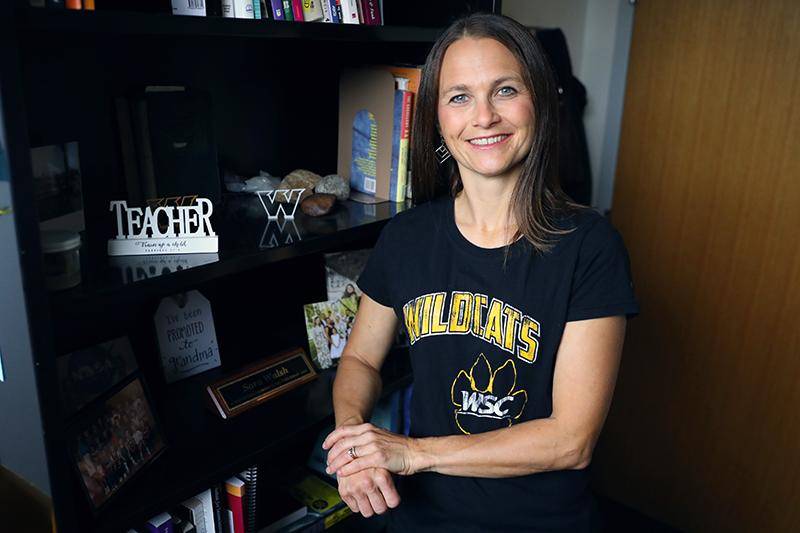
Featuring Dr. Sara Walsh, professor of education at Wayne State.
Inheriting a service-learning project from a former professor 11 years ago has helped Dr. Sara Walsh shape the lives of hundreds of elementary school children and Wayne State College education students. Walsh, a professor of education at Wayne State, is the subject of this week’s Faculty Spotlight Series.
“The most effective educators are more than purveyors of knowledge; they are providers of opportunities,” said Walsh, a native of Newcastle, Neb., who began teaching at Wayne State in 2013. “Our program strives to lay the foundation for future educators, so they have the potential to make a profound positive impact on students' lives.”
Walsh said the service-learning project, which is conducted at Ike’s Lake near Wayne, provides pre-service teachers an opportunity to teach elementary students in a non-traditional classroom setting where they are challenged to utilize the environment as a teaching tool. The pre-service teachers implement the 5E model of instruction, while also implementing what they have previously learned about effective teaching, to five different groups of elementary students in a station-rotation format.
“This experience allows them to see the impacts of their instructional design on real students, and to reflect in the moment to make tweaks as they lead each group through their learning opportunity,” said Walsh. “The feedback from both teachers and parents of our third-grade partner schools is that their children were not only excited to discuss what they experienced at Ike's Lake on that day, but that they continued to make connections between these experiences and new material throughout the year.”
Originally, the Ike’s Lake service-learning project was offered only once a year to Wayne elementary students; however, Walsh has expanded it to once each semester. The partner schools are now Wayne Community Schools, Wayne St. Mary's School, Wakefield, Allen, Emerson-Hubbard, and Laurel-Concord-Coleridge schools.
People who have a passion for knowledge and sharing it to build a better world are a perfect fit for a career in education. Pursuing a teaching degree from Wayne State allows students to follow in the footsteps of thousands of students before them. Wayne State builds outstanding education professionals for schools in Nebraska and around the world. In fact, 1 in 10 Nebraska teachers has at least one degree from Wayne State.
Wayne State provides many avenues for students to gain an edge on other teacher candidates by ensuring they have quality, hands-on work experience before graduation. Wayne State’s faculty members work with students in a personalized setting, delivering classwork and field experiences that introduce them to classroom management and curriculum development before they take their first teaching position. Wayne State students can also earn multiple teaching endorsements in four years. When pairing subjects like ESL, reading and writing, and special education with other endorsements, Wayne State graduates have an advantage over other job candidates for teaching positions that are in high demand.
Before coming to Wayne State, Walsh taught science classes for grades 7-12 at Elgin Public School in Elgin, Neb., for 11 years. She also creates science learning opportunities throughout the year for STEM camps, libraries, childcare centers, and local events.
At Wayne State, Walsh serves as chair of the Academic Policies Committee and has implemented the co-teaching during clinical practice model. She serves as the contact for this program and leads the training workshops.
Walsh's research interests include educational psychology, science education, and intrinsic motivation.
Walsh earned her bachelor’s degree in Secondary Education and Biology (minor in Chemistry) from Briar Cliff University, her master’s degree in Education (Curriculum and Instruction) from Wayne State College, and her Ed.D. in Curriculum and Instruction from the University of South Dakota.
Fun Fact: “My family raises most of our own food. In addition to meat, eggs, and fresh garden produce, we also preserve about 1,000 quarts of vegetables and fruit each year.”